Episode 5 — Explain OT Versus IT: Convergence, Responsibilities, and Operational Constraints
In this episode, we’re going to clear up one of the biggest sources of confusion for beginners: the difference between operational technology and information technology, and what it means when the two worlds start to overlap. Most people have seen I T in everyday life, because it shows up in laptops, email, Wi-Fi, websites, and the systems that keep an office running. O T is different because it is tied to physical processes, like making products, moving water, generating power, controlling building systems, or managing transportation. That difference sounds simple until you realize that modern organizations connect these environments for efficiency, visibility, and remote operations, and once they connect, the risks and responsibilities start blending. Beginners often expect that security rules should work the same way everywhere, but the constraints in O T can make a standard I T approach unsafe or disruptive. At the same time, pretending O T is completely separate is also wrong, because modern plants and critical infrastructure increasingly depend on networks, data, and shared services. This lesson is about learning the real differences, understanding what convergence looks like, and seeing why responsibilities must be clearly defined so security improves without breaking operations.
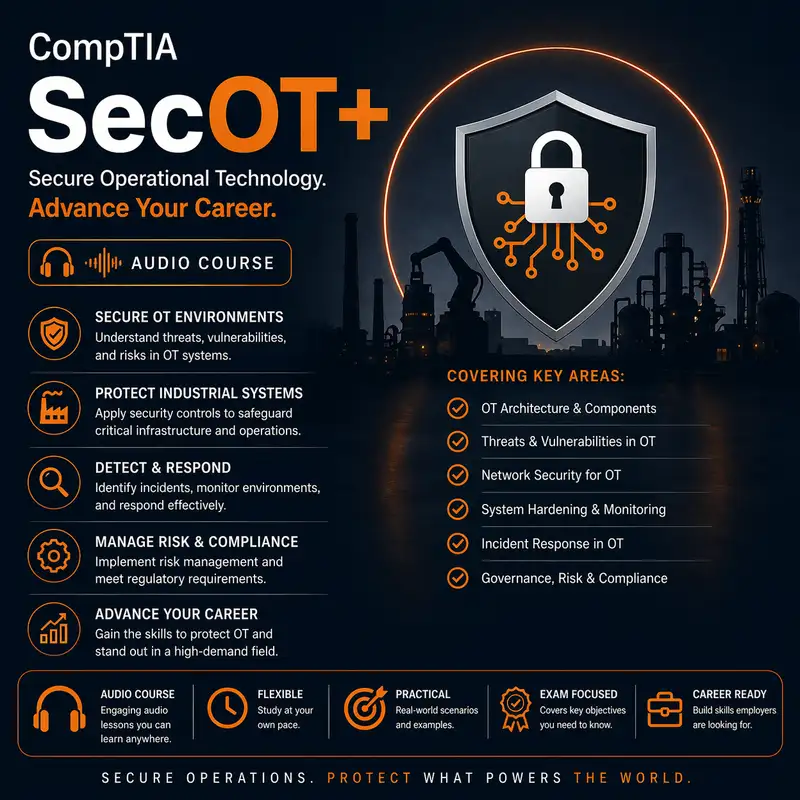
Before we continue, a quick note: this audio course is a companion to our course companion books. The first book is about the exam and provides detailed information on how to pass it best. The second book is a Kindle-only eBook that contains 1,000 flashcards that can be used on your mobile device or Kindle. Check them both out at Cyber Author dot me, in the Bare Metal Study Guides Series.
A good starting point is to define what each environment is trying to achieve, because goals drive decisions. In I T, the systems are mainly about storing, processing, and sharing information, and the business impact of a problem is often tied to productivity, confidentiality, and service availability. In O T, the systems are mainly about controlling a physical process, and the business impact of a problem can include safety, equipment damage, environmental harm, and interrupted production. That does not mean I T never cares about safety or that O T never cares about confidentiality, but it does mean the priorities often show up in a different order. Another difference is the kind of time pressure each environment lives under. I T systems might tolerate a brief reboot, a patch window, or a service restart, while O T systems may run continuously and be designed to avoid stopping because stopping can create hazardous conditions or expensive downtime. When you understand that the “product” of O T is a physical outcome, like pressure, temperature, speed, or flow, you start to see why certain security actions must be carefully controlled. In a beginner’s mind, a quick update seems harmless, but in O T, a quick update can become an unexpected process change.
The next difference is the nature of the devices and how long they are expected to live. I T endpoints like laptops and phones are replaced frequently, and servers might be refreshed every few years, so modern security features can be adopted relatively quickly. O T devices often last much longer, sometimes decades, and the environment may include controllers, sensors, and operator stations that were designed before modern security expectations. That long life is not because the organization is lazy, but because industrial equipment is expensive, specialized, and sometimes certified or validated for specific uses. Changing a component may require safety testing, process validation, vendor support, and planned outages, which can be difficult to schedule. Many O T devices also have limited computing resources, meaning they cannot run heavy security tools without affecting performance. Some systems are built to prioritize deterministic behavior, meaning they must respond in predictable timing, and extra load can create unacceptable delays. These constraints do not excuse insecurity, but they explain why O T security must be risk-based and careful. A beginner should learn to respect that “just patch it” is not always the first move in O T, even if patching is important.
Convergence is the process of I T and O T becoming more connected, and it is happening for reasons that are easy to understand. Organizations want centralized monitoring, remote support, data analytics, predictive maintenance, and better coordination between business decisions and operational reality. Data from O T can help reduce waste, improve quality, and catch equipment issues early, and those are valuable outcomes. Convergence also happens because the underlying technology is increasingly similar, with Ethernet, standard servers, virtualization, and common operating systems appearing in industrial environments. Once common technologies appear, common vulnerabilities can also appear, and attackers can use familiar methods to reach systems that control physical outcomes. Convergence often brings I T tools into O T, like logging, identity management, and network monitoring, but those tools must be integrated in a way that respects O T constraints. Beginners sometimes imagine convergence as a simple merge where everything becomes one network, but a mature view is that convergence is selective and controlled. The goal is connectivity that provides value while preserving safety and stability.
A major challenge in convergence is that responsibilities can become unclear, and unclear responsibilities create gaps where problems grow. In many organizations, I T teams are responsible for corporate networks, email, user accounts, and business applications, while O T teams are responsible for plant systems, control networks, and process reliability. When these systems connect, questions arise like who approves changes, who patches what, who monitors alerts, and who responds when something goes wrong. If nobody owns a responsibility, it may be ignored, and if two teams both assume the other team owns it, it may be ignored twice. Responsibilities also include who has authority to make a system unavailable, even briefly, because in O T, availability can be tied to safety and production. A beginner might assume that security always gets to override operations, but in practice, decisions must balance risks, and authority must be established ahead of time. Clear responsibility models also reduce conflict, because teams stop blaming each other and start coordinating. The exam mindset you should build is that security is not only about controls, it is about governance, communication, and agreed decision rights.
Operational constraints are the real-world limits that shape what actions are acceptable in O T, and they show up in everyday decisions. One constraint is safety, meaning actions must not increase the risk of injury or create unsafe process states. Another constraint is uptime, because many processes are designed to run continuously, and stopping them can be costly or dangerous. Another constraint is determinism, meaning control traffic and control logic must occur with predictable timing, and delays can cause instability. Another constraint is vendor dependence, where only certain changes are supported, and unsupported changes can void warranties, break certifications, or create untested behavior. There are also physical access constraints, because O T equipment may be in hazardous areas or remote locations, making hands-on work difficult. These constraints can make standard I T practices, like frequent scanning, aggressive blocking, or rapid patching, risky if applied without adjustment. The beginner takeaway is that O T security is often about reducing risk while preserving the process, and that means you must understand the process context. Security that breaks operations is not successful security, especially when the process controls real-world outcomes.
One area where I T and O T differ is how they handle changes, because change is one of the most common sources of incidents in both worlds. In I T, change control exists, but many organizations can move quickly, using automated updates and frequent releases, especially in cloud environments. In O T, change control is often slower and more formal because changes can affect safety and production, and because systems may have tight dependencies. A small change in a control system can create a large effect, like changing the behavior of an alarm, modifying a set point, or altering a sequence that controls a machine. Even a network change can affect timing and communication, which can affect control performance. That does not mean O T never changes, but it often changes with more planning, more testing, and more coordination. For beginners, this is an important mental shift: speed is not always a virtue, and cautious sequencing is often the safer strategy. If you learn to think in terms of controlled change, many exam questions become easier because you will choose options that respect the environment’s stability needs.
Another difference is how incidents are perceived and handled. In I T, incidents often focus on data compromise, account takeover, malware, or service disruption, and the response may include isolating devices, resetting credentials, or restoring systems from backups. In O T, an incident can include abnormal process behavior, loss of visibility, unexpected alarms, or equipment behaving in ways that threaten safety and production. The response may need to prioritize stabilizing the process, maintaining safe operation, and coordinating with operations teams before taking aggressive containment actions. For example, disconnecting a device might stop an attacker, but it might also stop monitoring or control signals that operators rely on to keep things safe. O T incident response often requires collaboration between engineering, operations, maintenance, and security, because the right action depends on the physical state of the process. Beginners should understand that you do not import an I T incident playbook into O T without adaptation, because the consequences of isolation and shutdown are different. A good mental model is that in O T, the process state is part of the incident, not just the network state.
Even terminology can create confusion in converged environments, because the same word can mean different things. In I T, an operator might mean someone who runs a computer system, while in O T, an operator is often the person responsible for running the physical process through an interface. In I T, a controller might mean a domain controller that manages logins, while in O T, a controller can mean a device that directly influences machinery. In I T, a patch might be a routine update, while in O T, a patch might require extensive validation and a planned outage. These differences matter because miscommunication is a real risk, especially when teams collaborate during incidents or maintenance windows. Convergence increases the chance of these misunderstandings because more people from different backgrounds are involved. The safest approach is to speak clearly, define terms in context, and confirm understanding before taking action. This is not about being overly formal, it is about preventing the kinds of assumptions that create safety or availability problems. On an exam, clarity is tested indirectly through scenarios that reward the choice that respects roles and constraints.
Another part of convergence is architecture, meaning how networks and systems are connected, and why boundaries matter. In I T, it is common to have broad connectivity inside a corporate network, with many services accessible across the environment. In O T, broad connectivity can increase risk because it creates more pathways to control systems, and it can increase the blast radius of an incident. Converged environments often need segmentation, controlled access, and monitoring that is designed with O T traffic patterns in mind. A beginner does not need to memorize specific architectures to understand the principle that O T systems should not be exposed unnecessarily. The reason is not paranoia, it is risk management, because the physical process needs stable, predictable operation. Convergence does not mean removing boundaries, it means designing boundaries that allow necessary data flow while restricting unnecessary access. When you keep that principle in mind, you can reason through many security questions by asking whether an option increases exposure without operational benefit. Good answers often preserve necessary communication while minimizing unneeded pathways.
To connect responsibilities and constraints in a practical way, imagine a situation where a vulnerability is discovered in a system that exists in both I T and O T, like an operating system component or a shared service. An I T mindset might push for immediate patching across all systems, while an O T mindset might push for careful testing and scheduling. The correct approach is not to choose one mindset and ignore the other, but to coordinate and manage risk, perhaps by adding temporary protections while planning a safe update. This is where roles and governance matter, because someone must have authority to approve the timing, the testing, and the compensating controls. It is also where communication matters, because leadership needs to understand tradeoffs, and operations needs to know what changes are coming. For beginners, the lesson is that O T security is often about building a safe path to improvement rather than demanding instant perfection. The exam may present choices that sound like strong security but ignore operational reality, and your job is to choose the option that reduces risk responsibly. When you learn to balance, you become better at both security and safety thinking.
To close, the difference between O T and I T is not a simple line, but a difference in purpose, priorities, device lifecycles, and acceptable risk, and convergence is the growing overlap where these differences must be managed rather than ignored. O T focuses on controlling physical processes, which brings safety, uptime, and determinism into the center of decision-making, while I T focuses on information systems where updates and changes can often happen more quickly. Convergence brings benefits like visibility and efficiency, but it also brings shared vulnerabilities and shared responsibilities that must be clearly defined to avoid gaps. Operational constraints are not excuses, they are realities that shape which security actions are safe and effective, and good security respects them while still reducing risk. When you approach O T versus I T with this balanced mindset, you stop trying to force one world to behave like the other and instead learn to coordinate them responsibly. That mindset will serve you throughout SecOT+, because many questions are really testing whether you understand context, roles, and tradeoffs. If you can explain these differences clearly and choose actions that preserve safety and operations while improving security, you are thinking the way the exam is designed to measure.